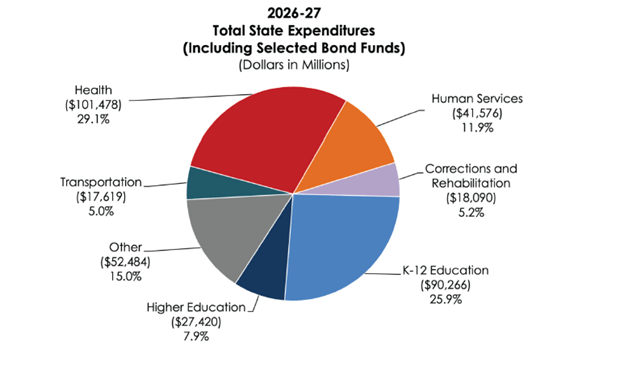
In Part II of this series, we continue our review of where your taxes dollars go. After tackling Florida’s $137.5 billion spend fest in Part I1, California is up next. Given their larger population, the government proposed a whopping $348.9 billion for the state’s 2026-27 budget. Including additional federal and local taxes, that total funding balloons to $608 billion (read on to see the math). Let’s say that again. $608 billion which more than the Gross National Product of the vast majority of countries in the world. And yet they still want to raise taxes. Sound crazy? Yup. Wait until you see what Californian’s are getting for turning over their hard earned dollars to the state. We’ll start with the break down of the $348.9 billion in California’s proposed budget2.
Health & Human Services: Wealth Distribution 101
California’s Health & Human Services dominates the state budget, gobbling up 41% of the pie. That’s a cool $143 billion in “state funds” alone—mostly for Medicaid and Medi-Cal, which are taxpayer funded health insurance for low income residents.
But if you’re a glutton for punishment and actually read the Governor’s budget document, the numbers get even bigger. The state claims the total Health & Human Services budget is actually $343.6 billion2. Wait, where did the other $200 billion come from?
It’s simple: our friendly pie chart above only shows the money California shakes out of its own residents. That “missing” $200 billion—the lion’s share of the program—comes straight from the federal government as reimbursement for Medicaid / Medi-cal and other direct benefits to California residents.
That’s right. Every taxpayer in America is currently chipping in more for California’s healthcare than the people actually living there pay. Sounds fair, right? So keep grinding and keep paying those taxes, everyone—California has bills to pay, and apparently, they’re yours too.
Education: Paying for Life
Alright catch your breath and let’s ease into a nice $90 billion for K – 12 education (see pie chart above). Oh wait, there’s more. So much more to the tune of a $150 billion when we remember to add local properties taxes for California counties and of course more money from the Federal government3. That’s a whopping $27,418 per student3…compared to the $11,600 per student that Florida spends4,5. Clearly this extra money must lead to more educated students on the West Coast…of course it does. Yeah. Wink. Wink.
And remember, this is like the graduation gift that keeps on giving…even after you or your kids graduate from high school, you get to keep on paying for the rest of your life. Congratulations!
Let’s throw in another $27 billion for higher education (see pie chart above) to pay for California University system, California State University system, and California community colleges. Now if you or your kids go to college as in-state residents, this covers roughly half the cost. So there’s some benefit. If your family goes out of state or to private universities, well then the state of California thanks you for your contributions…
All total that brings us to a combined $177 billion for K-12 and higher education across state, local, and federal taxes, much higher than what the state fund only budget shows.
Other: What Exactly is “Other Stuff”?
Ah yes, our favorite thing to spend $52 billion on: other stuff. Sounds critical to taxpayers…but um what is this other stuff? First up, we’ve got a cool $20.5 billion for “Government Operations.” This includes the “Broadband for All” initiative—to provide high-speed internet to underserved rural or tribal areas —and the eternal “Technology Modernization” black hole to upgrade various government computers, internet, websites. There’s about $5 billion hodgepodge for Labor and Workforce Development, Housing and Homelessness, and Business and Consumer Services. All sound like well-intentioned programs to train the workforce for better jobs, reduce homelessness, and help our small businesses. However, looking at the accomplishments listed2, it’s hard to separate what’s a government handout vs what’s spent on actually improving the problems.
On the “Maybe This Isn’t a Total Waste” list, we have $9.5 billion for Natural Resources. This funds Cal Fire (because the state is perpetually an ashtray), Water Resources (for the droughts and floods we can’t decide between), and Parks & Recreation. It also covers Environmental Protection ($4.8 billion) for things like landfill management and pesticide regulation—actual government jobs that don’t involve a PR team.
Almost last but not least, there’s $12.1 billion for the Legislative, Judicial, and Executive branches—you know, the actual government people who are supposed to be running the show. This is clearly an essential function but like other states, it’s dwarfed by massive wealth redistribution programs.
Finally, there’s some good news as the budget estimates over $1.4 billion2 spent on “Tax Relief” to provide partial refunds to low income and middle-class taxpayers. Of course, why the government taketh the money just to give it back remains one of the mysteries of universe.
Transportation: Roads and CHP and High-Speed Rail, Oh My!
We’re hitting the home stretch of this budget, and we’ve found the remaining $17.6 billion California decided to toss toward transportation. On paper, it sounds like a lot, but in a $608 billion budget, it’s basically the loose change found in the governor’s sofa.
Here’s the “priority” list:
- Caltrans ($8.4 billion): Tasked with maintaining the roads, highways, and infrastructure that always seems to be under construction.
- California Highway Patrol ($3.2 billion): To handle law enforcement and traffic safety.
- Department of Motor Vehicles ($1.58 billion): To ensure your three-hour wait for driver’s licenses, registrations, and anything else you can’t do online
All of these are critical services, right? So, the next time you’re sitting in a pothole-induced traffic jam, looking for law enforcement after an accident, or watching the Department of Motor Vehicles clock tick toward eternity, remember this. It’s not that the state doesn’t have the money. They simply to chose spend on other things – mostly hand-outs and wealth redistribution.
And of course, we can’t forget everyone’s favorite money pit: the High-Speed Rail. This year, California proposed a “meager” $1.46 billion in state funding. After a decade of burning through billions with nothing to show for it but some very expensive concrete in the Central Valley, we’ll let you decide if this train is finally coming in or if we’re all just being taken for a ride.
Corrections and Rehabilitation: Essential but effective?
About $14 billion of the $18 billion in this pie slice pays for the California Department of Corrections and Rehabilitation to oversee prisons for serious and violent felons, parole, and rehabilitation programs. Another $1.3 billion is for the Department of Justice. The rest goes to supplement local law enforcement and fund public safety initiatives. All essential government functions to hopefully put the criminals away and keep them there. Whether these funds are efficiently and effectively spent is another story.
A $608 Billion Math Problem That We’re All Paying for
So, what does this mountain of taxpayer cash actually mean? Let’s recap the “official” numbers before the accountants start sweating.
The California budget isn’t just the governor’s proposed $348 billion headline figure. Once you toss in the federal handouts and local property taxes, we’re looking at a staggering $608 billion. (That’s $348 billion state funding + $200 billion for additional federal funding for Medicaid + $60 billion federal and local funding for education).
What are you getting for that price tag? Well, that depends on how much you like wealth redistribution. Over 85% of the budget is essentially moving money from one pocket to another—mostly for Medi-Cal and education. And since that 70% includes federal funds, it’s not just Californians footing the bill; the rest of the country is subsidizing the dream, too.
If you’re on the receiving end of those benefits? Great. You’re winning. For everyone else across the country? It’s a massive, undeniable black hole of cash.
The “Lack of Funding” Myth
Whenever you hear a politician whine that there’s “no room in the budget” for essential services, feel free to roll your eyes. They aren’t short on cash; they’re just spending it elsewhere. Because they’ve prioritized redistribution, the “boring” stuff gets the leftovers: Cal-Fire (you know, for the state that’s always on fire), state law enforcement and prisons, road and highway maintenance, water quality, and public parks and beaches.
Do they really need to hike you taxes again? Remember they have more of your money (for free) than most countries’ economies generate! There’s plenty of money; they just chose to spend yours on someone else.
The Sunshine State Showdown
As a parting gift, let’s compare to Florida from Part I of this series. Their total budget—federal and local crumbs included—is $137.5 billion1. With 23.5 million residents6, that’s about $5,841 per person.
And California? With 39.4 million people6, they’re burning through $15,431 per person.
That’s nearly three times more than Florida. Are Californians three times happier? Are the roads three times smoother? Are the students three times smarter? If any Californians actually believe you’re getting triple the value for your money, let us know—we have a lovely bridge in Brooklyn we’d like to sell you.
Sources:
- https://troll502xzoid.blog/2026/04/29/where-do-your-tax-dollars-go-part-i-welcome-to-floridas-fiscal-wonderland/
- https://ebudget.ca.gov/2026-27/pdf/BudgetSummary/FullBudgetSummary.pdf
- https://calmatters.org/commentary/2026/02/california-school-systems-education-spending/#:~:text=The%202026%2D27%20budget%20that,average%20of%20$27%2C418%20per%20pupil
- https://www.flgov.com/eog/news/press/2025/governor-ron-desantis-signs-florida-fiscal-year-2025-2026-budget#:~:text=The%20budget%20builds%20on%20Florida’s,program%E2%80%94the%20Family%20Empowerment%20Scholarship
- https://usafacts.org/answers/what-percentage-of-public-school-funding-comes-from-the-federal-government/state/florida/
- https://www.census.gov/topics/population.html
 Troll-E-Trolls R Us
Leave a comment