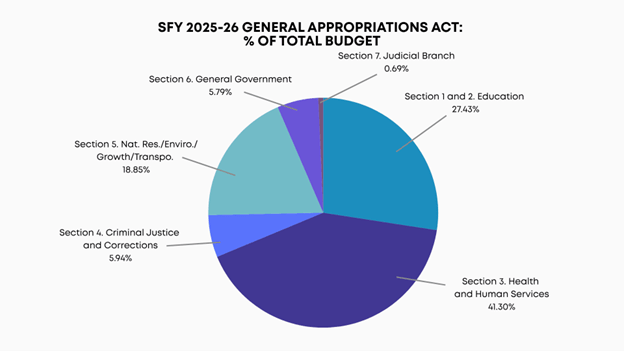
Last year, Florida’s government approved $115 billion for the state’s 2026 budget. That’s billion with a B. Add in local and federal taxes for education, and Florida’s spending over $137.5 million of your money. And because nothing says “fun weekend reading” like government spending, let’s break down where your tax dollars go starting with the pie chart for the $115 billion state budget below1…
Health & Human Services ($47.6 billion) The Budget Black Hole
We’ll start with the biggest slice of the pie, Health and Human Services, weighing at 41% of the $115 billion state budget or a tidy $47.6 billion. And what the heck is Health and Human Services? lt’s basically code for Medicaid — taxpayer‑funded health insurance for people earning less than twice the federal poverty line (or roughly anyone who make less than $35,000 or a bit more if they have a family)2.
In total, about 20% of Floridians use Medicaid3. So yes, 41% of the budget benefits 20% of the people. Fair? Unfair? Depends on whether you’re paying or receiving.
But here’s the plot twist: Most of that money isn’t even Florida’s. More than half of it is reimbursed by the US government, meaning everyone in every state helps pay for Florida’s Medicaid (and each state’s Medicaid for that matter). Teamwork makes the dream work, right?
Education ($31.5 billion): Uh…Try Again. It’s $54 billion
Next up: $31.5 billion for public education1. If you grew up in Florida, have kids in Florida, or once drove past a school in Florida, congratulations — you’re a beneficiary.
But wait. You already pay property taxes for schools. So why are your state taxes also paying for schools? Because schools need more money. Mystery solved. When we add in the $13.6 billion in property taxes4 plus another $8.9 billion from the federal government5, education funding across balloons to $54 billion. In fairness, Florida spends roughly $9,130 per student per year6 ($11,600 per student7 including federal funding), which doesn’t sound too high compared to other states.
So, who benefits? Well, about 40% of U.S. households have kids under 188 and roughly 14% of Florida students attend private school9, so the majority still rely on public education).
Throw in older Florida residents who attended school in state, and the number is even bigger. If you moved to Florida or didn’t send kids to school, then you’re out of luck.
About $6B of the budget goes to Florida state universities and college. So, if you want some of your money back, make sure your kids go to college in state!
Natural Resources / Environment / Growth / Transportation ($21.7 billion): What’s All This?
Back on our pie chart, we come to Nat. Res / Enviro. / Growth / Transpo. at 18.85% of the budget or a mere $21.7 billion for whatever this alphabet soup is. Let’s decipher it…the abbreviation stands for Natural Resources, Environmental Issues, Growth Management and Transportation Expenditures…
Clear as mud, right? Here’s the breakdown10:
- Department of Transportation: $15.1 billion. Highways, resurfacing, bridges, public transit, and yes — Amtrak, the “private” company that somehow always needs public money.
- Department of Environment: $2.5 billion. Everglades restoration, water quality, flood resilience. Hard to argue with drinkable water and “please don’t let the state sink.”
- Department of Agriculture (FDACS): $2.1 billion. Land conservation, wildfire prevention, and a buffet of $10–50 million programs. Sounds like lots of pet projects. Hard to track which benefit which group
- Growth (Commerce): $1.8 billion. Affordable housing, broadband expansion, disaster recovery. Lots of stuff in here to give certain people money.
Most of these costs still are outrageously high in the billions. The general public does benefit from roads and environmental care, but there’s a lot of special interest group hand-outs mixed in.
Criminal Justice & Corrections ($6.8 billion): To Keep Your Safe
But wait there’s more…um…good citizens…hear us out on this one. Shouldn’t the government actually have some people to enforce the laws and maybe have a way of preventing people from committing future crimes. Crazy talk, right? Less than 6% of the budget goes to police, prisons, and law enforcement — you know, the stuff government is actually supposed to do.
So, remember the next time some politician says there isn’t enough funding for the police, they’ve got $6.8 billion to help you… but given there’s over $137.5 billion in the budget, it’s not that there isn’t enough taxpayer money…it is the fact that politicians chose to spend it on something else….
General Government ($6.7 billion): To Make Rules
So what does that leave? Oh, a mere 5.79% or $6.7 billion goes to run the actual government agencies, administration, staff. Let’s repeat that. Florida’s got a $115B of taxpayer money and less than 6% is to actually run the government itself. This just shows how incredibly and bloated state budget actually is.
Judicial Branch ($741 million): Court Is In Session
Last and apparently least, we come to the judicial branch for all the courts, judges, and justice system at $741 million…a massive amount of money for regular people but it’s a rounding error in the total budget for an incredibly important function of government.
So What Does It All Mean?
Well, first of all, when we add in federal and local taxes for education, the Florida’s government expense grow from $115 billion from state taxes over to $137.5 billion. Then after sifting through all the charts, percentages, and budget line items, a clear pattern emerges: most of Florida’s tax dollars—much like those in other states—fund programs that redistribute wealth. Medicaid is the most straightforward example. Taxpayers contribute, and the state provides healthcare to residents who otherwise couldn’t afford it.
Education works the same way, though in a more nuanced form. High-earners pay more in taxes than others for the same services. And people without school age kids will keep footing the bill for life.
Transportation and environmental is a bit kinder to taxpayers, as everyone benefits (or doesn’t benefit) equally.
The kicker is that such small portion of budget goes to the core functions that define a government. Only about 12–13% of spending—roughly $13 billion—funds police, fire services, administrative agencies, lawmakers, and the courts. In other words, a relatively small share of tax dollars supports the machinery of government itself.
If these facts and confusing numbers were better known, people might choose to vote differently. While Florida’s has a reputation for being fiscally responsible, it’s hard to imagine people really understand how little they get for their tax dollars in terms of actual government services.
Sources:
- https://www.fl-counties.com/sfy2025gaa/
- Florida Medicaid Eligibility: 2026 Income & Assets Limits
- https://usafacts.org/answers/how-many-people-are-on-medicaid-in-the-us/state/florida/
- https://www.fldoe.org/file/7507/25-26FEFP3rdCalc.pdf
- https://www.ed.gov/media/document/state-tables-state-fiscal-year-2024-fy-2026-presidents-budget-110251.xlsx
- https://www.flgov.com/eog/news/press/2025/governor-ron-desantis-signs-florida-fiscal-year-2025-2026-budget#:~:text=The%20budget%20builds%20on%20Florida’s,program%E2%80%94the%20Family%20Empowerment%20Scholarship
- https://usafacts.org/answers/what-percentage-of-public-school-funding-comes-from-the-federal-government/state/florida/
- https://www.census.gov/library/stories/2024/11/family-households.html
- https://teachcoalition.org+/research/update-on-florida-jewish-school-enrollment-2024-5/#:~:text=The%20Florida%20Department%20of%20Education,%E2%80%A2
- https://www.flsenate.gov/Session/Bill/2025/2500/BillText/er/HTML
 Troll-E-Trolls R Us
Leave a comment